
- October 5, 2026
- Vidyashilp School
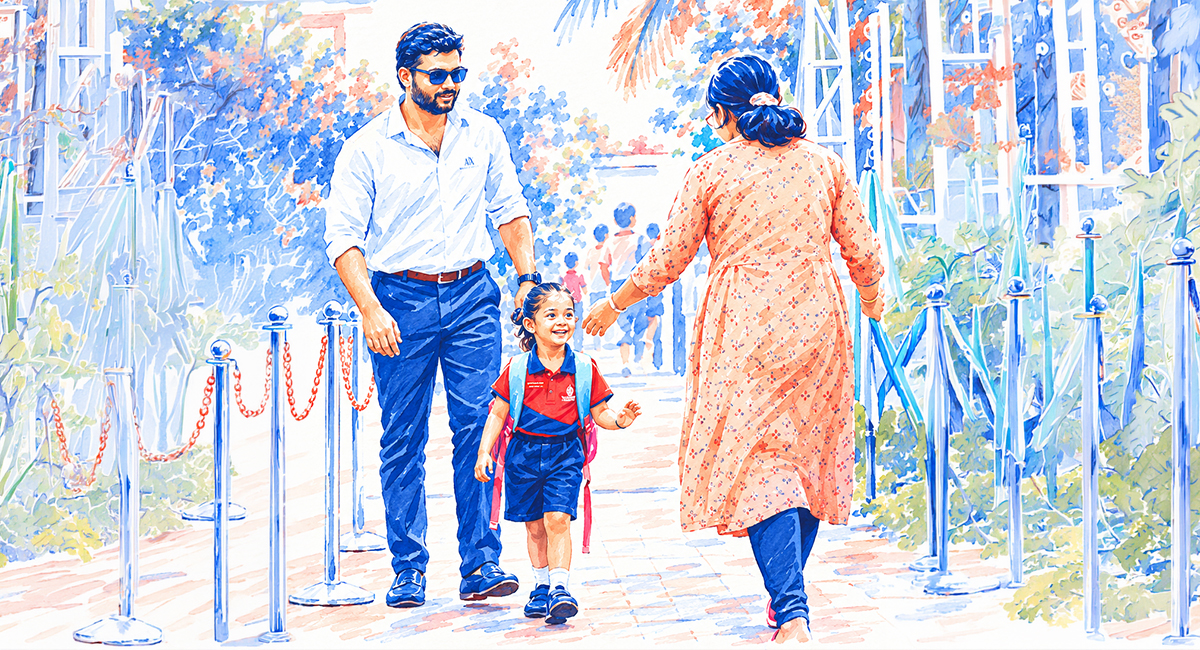
Starting at a new school is one of the bigger events in a young child’s life, not because of the academics, but because of everything else. The unfamiliar faces. The new routines. The unspoken question most children carry through the first few weeks is: Will I find my place here?
Most parents who’ve gone through this know that the worry isn’t really about curriculum or facilities. It’s simpler and harder than that. It’s whether their child will be okay.
At Vidyashilp School, the first 100 days of a new child’s experience aren’t treated as a settling-in period to get through. They’re treated as a foundation worth building deliberately — a distinct phase of a child’s time at school that shapes everything that follows.
Why the First 100 Days Matter More Than the First Day
The first day gets all the attention: the photographs, the new shoes, the dropped-off-at-the-gate moment. But adjustment doesn’t happen in a day, and research on transition to a new school is consistent on this: most children need several months, not weeks, to genuinely settle into a new school environment.
What happens in the early weeks matters, but it matters mostly because of what it sets in motion. A child who finds their footing in the first term tends to build confidence, friendships, and a sense of security that feeds directly into how they engage with learning later. A child who doesn’t find that footing carries the weight of uncertainty into the classroom.
This makes the first 100 days not a formality but a foundation. What a school chooses to do with this window and how intentionally it’s built has a real and lasting effect.
What “Settled” Actually Looks Like at This Age
It’s worth being clear about what settling in actually looks like, because it doesn’t always look the way parents expect. A settled child isn’t necessarily the most confident one in the room or the one who bounced in on day two without a backward glance.
Research points to a few more reliable signs that a child is genuinely adjusting well:
- They’ve connected with at least one peer — not a best friend necessarily, just someone
- They’re willing to try things in class even when they’re unsure of the outcome
- They can ask for help without hesitation — from a teacher, from a classmate
- They talk about school at home without being prompted, in any direction
The last point matters even when what they say is mundane. A child who tells you unprompted what happened at lunch is a child who’s processing school as part of their world, not something separate and strange.
Emotional adjustment and academic engagement are genuinely connected. A child who doesn’t feel safe in their environment doesn’t learn as well as one who does — this isn’t an abstract point; it’s a consistent finding across the research on child wellbeing at school.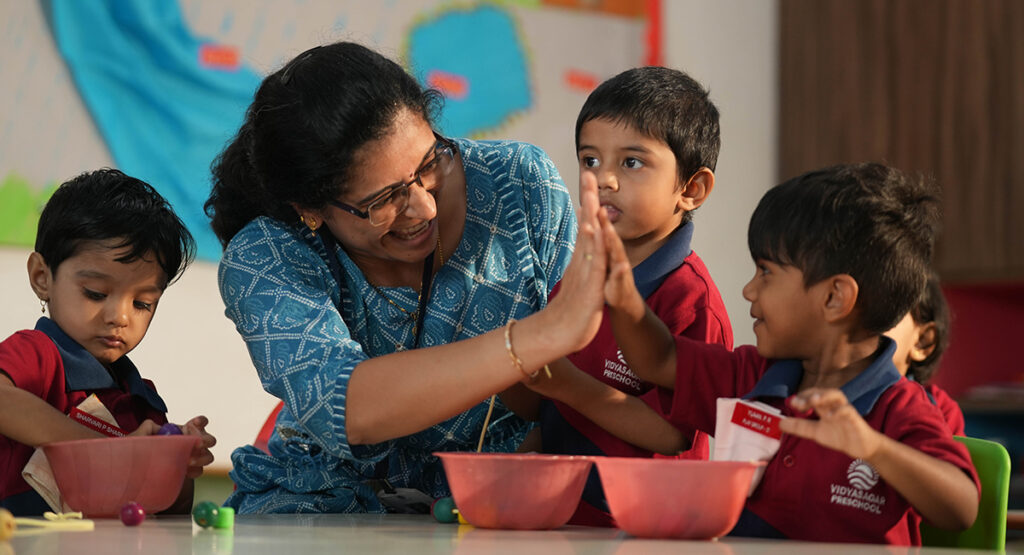
The Three Things Vidyashilp School Wants Every New Child to Feel
1. Known — Not Just Enrolled
There’s a real difference between a child who feels known by their teacher and a child who simply has a name on a register. The first learns differently. They take more risks, ask more questions, and recover faster when something goes wrong.
At Vidyashilp School, classes are structured in small groups of four within a class of 32. Eight teams, each visible, each with a teacher who can see what’s happening at the group level rather than managing a room of thirty individuals. The structure is designed so that every child is noticed — not just the ones who raise their hand the most.
The expectation is that teachers should know their students as people before they know them as learners. That order matters.
2. Safe Enough to Try and Get It Wrong
Psychological safety — the ability to attempt something without fear of embarrassment — is one of the most important conditions for learning. It’s also one of the easiest to accidentally undermine.
The 4 Cs framework at Vidyashilp School — Cooperative Learning, Communication, Cultural Anchoring, Critical Thinking — builds this by design. Children work in small teams, share their reasoning out loud, and arrive at answers together. When the work is collaborative, the risk of being wrong is distributed across the group. Getting something wrong in a team of four feels different from getting it wrong in front of the whole class. One builds confidence; the other quietly erodes it.
3. Part of Something — Not Just Attending
School belonging is one of the most well-documented predictors of long-term academic and social outcomes. Children who feel they genuinely belong at their school attend more consistently, engage more fully with learning, and report higher wellbeing – findings that hold across age groups and school settings.
At Vidyashilp School, belonging isn’t treated as a feeling that develops naturally over time if you just wait. It’s built into the everyday structure of the school, through collaborative learning, through Indian values and ethics integrated across subjects rather than reserved for a special event, and through a school culture built around how children treat each other rather than how they perform against each other.
What the School Environment Does — and Doesn’t — Do on Its Own
A well-designed school environment can support settling into a new school, but it can’t do the whole job. The physical campus, the classroom structure, and the timetable matter. They matter more than most schools acknowledge. But they aren’t the primary lever.
What the environment at Vidyashilp School provides:
- Purposeful class groups that make individual children visible
- Consistent daily routines that reduce the low-level unpredictability that exhausts younger children
- A campus where arts and sport are woven into the regular day — not treated as extras
What this doesn’t replace: the quality of the relationship between a specific child and their teacher, and the ongoing communication between the school and the family at home. Research on school transitions is clear on this point — peer support and warm adult relationships are the primary predictors of positive adjustment. Facilities help, but they’re downstream of the human relationships.
How Parents Fit Into the First 100 Days
Child wellbeing at school is a shared responsibility. Schools and parents working together consistently produce better outcomes than either working in isolation; a finding that shows up across nearly every study of school transition and adjustment.
What this partnership looks like at Vidyashilp School:
- Open communication: Parents sharing context about how their child is doing at home, especially in the first weeks, gives teachers information they can’t get from the classroom alone.
- Consistency between home and school routines: Predictable mornings and after-school routines help young children manage the cognitive load of a new environment.
- Parent-teacher interaction as ongoing: Not saved for formal report card meetings, but happening naturally through the term.
One practical note worth naming: a child who seems fine at school may not be fine, and a child who’s reluctant at drop-off may actually be adjusting well by mid-morning. Neither pattern is a reliable indicator on its own. Staying in regular contact with the class teacher through the first term gives both sides a fuller picture.
What the First 100 Days Are Not
It’s worth being equally clear about what this period isn’t.
It’s not an extended assessment window. A child’s adjustment in the first 100 days isn’t a test of their readiness or their personality, and treating it that way usually makes the adjustment harder, not easier.
It’s not the right time to push academic benchmarks before emotional grounding is in place. A child who is still finding their feet socially and emotionally isn’t in the best position to demonstrate academic capability, and measuring them at this stage tells you more about the transition than about the child.
And it doesn’t look the same for every child. Some children settle visibly and fast. Others take longer, quietly, and are no less fine for it. The range of what’s normal here is wider than most parents expect, and narrower than most worries suggest.
FAQs
1. What are the key emotional and social goals for a child’s first 100 days at Vidyashilp?
The three core goals are feeling known by their teacher, feeling safe enough to try and get things wrong, and feeling a genuine sense of belonging, not just attendance. These emotional foundations directly support academic engagement that follows.
2. How does Vidyashilp foster a sense of belonging and security for new students during their initial period?
Through small collaborative class groups, consistent daily routines, cultural values woven into regular subjects, and a school culture built around how children treat each other rather than how they perform against each other.
3. What specific activities or programs are in place to ensure a positive and welcoming experience for new children at Vidyashilp?
The 4 Cs framework: Cooperative Learning, Communication, Cultural Anchoring, and Critical Thinking shapes how classrooms are structured from day one, with team-based learning that builds connection and distributes the risk of being wrong.
4. How can parents partner with Vidyashilp to support their child’s positive adjustment during the first 100 days?
By staying in regular contact with the class teacher, maintaining consistent home routines, and sharing context about how the child is doing at home; information that teachers can’t always observe in the classroom.
5. How long does it typically take a child to settle into a new school?
Research suggests most children take up to six months to fully adjust. The first 100 days are the most critical window; what gets built in this period shapes confidence, friendships, and academic engagement for the term ahead.
Conclusion
The first 100 days at Vidyashilp School are built around one thing: making sure a child feels known, safe, and genuinely part of something before the academic work starts asking much of them. Everything else, including the learning, the results, the growth follows from that foundation.
A transition to a new school isn’t a problem to solve in a week. It’s a foundation being laid, carefully, over a term. The school’s job in that time is to make sure the ground is solid enough for everything that comes next.
If you’d like to see what a regular school day actually looks like, not the open day version, the ordinary Tuesday version, the doors are open.